

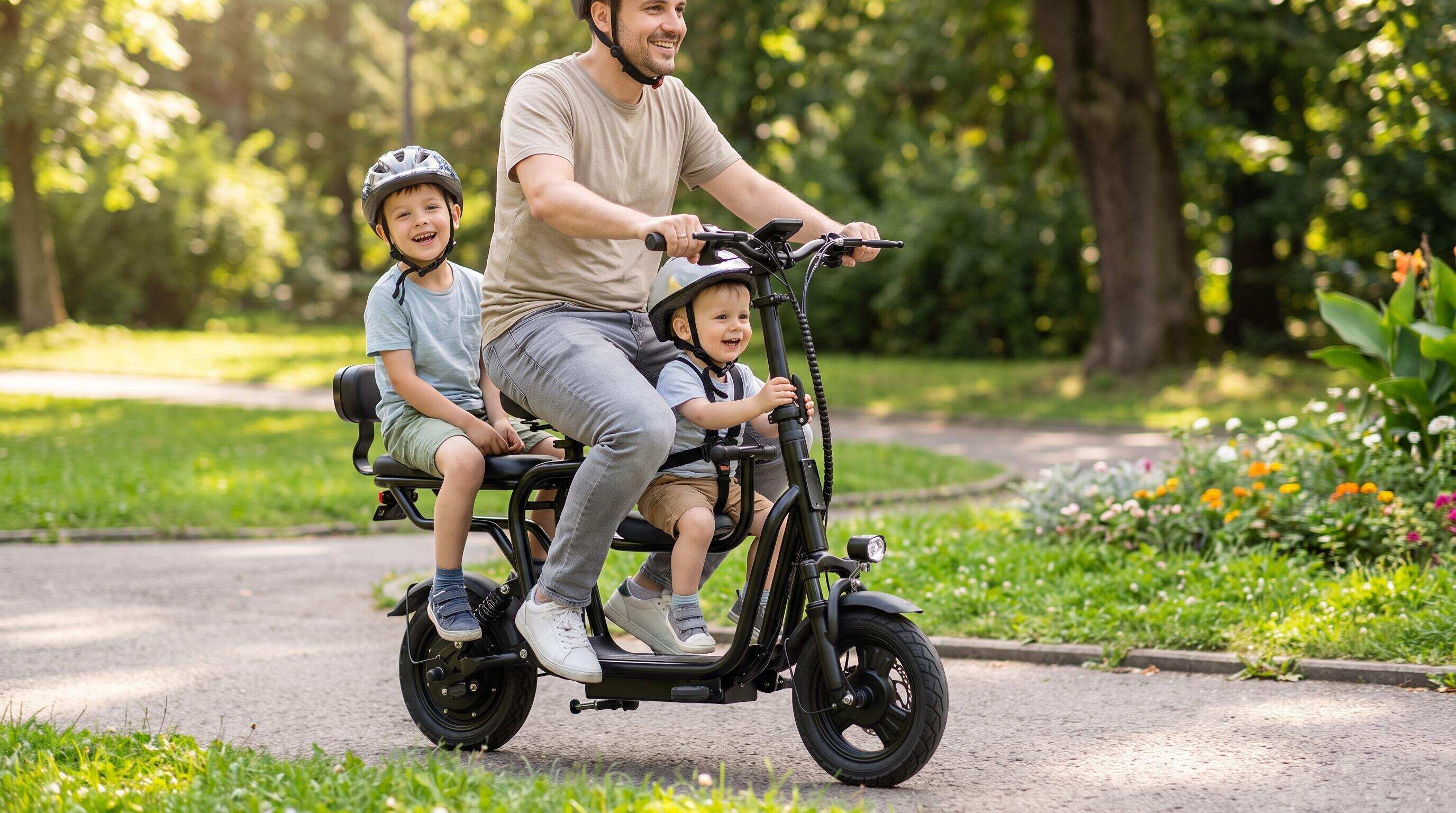
ALT: Parent riding a 3-seat cargo e-bike with two kids safely secured in front and rear seats
Riding With Two Kids on One E-Bike: What You Need to Know About 3-Seat Electric Bikes
Picture this: it's a sunny Saturday morning, you've got two kids bouncing with excitement, and the idea of loading everyone into the car for a short trip to the park feels exhausting before you've even started. You've heard about cargo e-bikes that can carry multiple passengers — but you're wondering whether they're actually safe, practical, and worth the investment for a family like yours.
Three-seat electric bikes — also called family cargo e-bikes or longtail/long-john e-bikes with dual child seating — are purpose-built electric bicycles designed to carry a rider plus two children simultaneously. In recent years, these bikes have moved from a niche product to a genuine family transportation solution across the United States, and the pattern we consistently see is that families who go through the process of understanding the category before they buy end up far more confident and satisfied with their choice.
This guide walks you through everything that matters: the essential features to look for, the safety standards involved, the real-world differences between seating configurations, and how to match the right setup to your family's daily riding life. Each point below was selected because it addresses a question or concern we see raised repeatedly by parents evaluating this category for the first time.
What Makes a 3-Seat E-Bike Different — and Why the Distinction Matters
Understanding the "3-Seat" Configuration in Family E-Bikes
A 3-seat e-bike is an electric bicycle specifically configured to accommodate one adult rider and two child passengers at the same time — typically through a combination of a front child seat, a rear child seat, or a specially designed extended cargo area with dual seating. This is fundamentally different from a standard e-bike with a single added child seat bolted to the rack, because the frame, wheelbase, motor placement, and braking system are engineered to handle a significantly higher combined load.
Best for: Families with two young children (generally under school age or in early elementary years) who want to replace short car trips with an active, emission-free alternative.
Watch out: Not every e-bike that can physically fit two child seats is actually rated or designed for that load. Always verify the manufacturer's stated payload capacity before adding any child seating accessories.
Cargo E-Bike Frame Geometry and Why It Changes the Ride
A cargo e-bike frame designed for child passengers — especially a longtail frame or a front-loader (bakfiets-style) frame — has a lower center of gravity, a longer wheelbase, and reinforced structural points compared to a standard bike frame. These engineering choices are what make two-child riding feel stable rather than precarious.
The longer wheelbase spreads passenger weight across a greater length, which reduces side-to-side rocking. The lower standover height helps a rider touch the ground more easily at stops, which is critical when you have 60–100+ pounds of combined child weight making the bike slower to lean back into balance.
Best for: Riders who are new to cargo biking and want a forgiving, stable platform as they build confidence with the extra weight.
Watch out: Longer wheelbase bikes handle turns differently than short-wheelbase bikes. Expect a wider turning radius, especially in tight parking lots or narrow paths.
Motor Power and Torque: The Real Numbers That Matter for a Loaded Bike
When a 3-seat e-bike is carrying two children plus a rider, the total payload can easily reach 300 pounds or more. A motor that feels peppy on a solo rider can feel sluggish and strained when asked to assist on a loaded climb. Mid-drive motors are generally preferred for cargo applications because they work with the bike's existing gears, providing consistent torque across varying terrain — including hills.
Hub motors (rear or front wheel) are more common on budget-friendly options and perform well on flat terrain. For families in hilly cities or neighborhoods with frequent elevation changes, higher torque ratings matter more than peak wattage alone.
Best for: Families who live in hilly areas or routinely carry fully loaded passengers for longer distances should prioritize mid-drive or high-torque hub motors.
Watch out: Higher-wattage motors draw more from the battery. If your rides are long, confirm that the battery range is rated under load — not just for a solo rider on flat terrain, which is how many manufacturers test.
Child Seating Positions: Front Seat vs. Rear Seat vs. Cargo Box
Three-seat configurations typically fall into a few approaches. The front-mounted child seat (handlebar-integrated seat) places one child in front of the rider, directly on the main frame — this gives the child excellent visibility and keeps them within the rider's sightline at all times. A second child is seated on a rear rack-mounted seat. Alternatively, longtail cargo e-bikes use an extended rear platform that can accommodate two child seats side by side or in tandem, keeping the front of the bike clear and improving steering response.
Front-loader cargo bikes (often called bakfiets or box bikes) use a large front cargo box where both children sit inside the box, in front of the rider. This keeps the children fully within the rider's view and provides a contained, enclosed riding environment.
Best for: Parents who want to keep both children visible at all times during the ride often prefer front-loader or longtail-with-rear-dual-seating configurations.
Watch out: Front child seats add weight ahead of the steering axis, which can make handling more sensitive — especially at low speeds. Practice in an empty parking lot before your first loaded family ride.
Child Restraint Systems and Harness Standards
Safety harnesses on child seats for e-bikes and cargo bikes are not yet uniformly regulated in the United States the way car seats are, but there are accepted standards in play. The European standard EN 14344 specifically covers child seats for cycles and is widely referenced by quality manufacturers globally, even for products sold in the US market. A well-rated child seat will include a five-point harness, foot straps or footrests, and a rigid backrest.
The Consumer Product Safety Commission (CPSC) in the United States oversees general bicycle safety and can act on unsafe products, but there is currently no dedicated federal standard equivalent to car seat regulations for bicycle-mounted child seats. This makes brand reputation and third-party testing more important when evaluating a seat's safety claims.
Best for: Parents who want the highest confidence in restraint safety should look specifically for seats referencing EN 14344 compliance, foot straps that prevent leg entrapment in the wheel, and adjustable harnesses that fit their child's current size.
Watch out: Child seat weight limits vary significantly. Most seats are rated for children up to approximately 40–48 pounds. Confirm both the seat limit and the bike's total payload limit — whichever is lower governs what you can safely carry.
Braking Systems: Why Two Kids Change the Stopping Equation
Braking a loaded cargo e-bike carrying two children is a fundamentally different physics problem than stopping an unloaded bike. The increased mass means longer stopping distances at any given speed, and the higher center of gravity means hard front braking can have more dramatic consequences. Hydraulic disc brakes are the gold standard for family cargo e-bikes because they provide consistent, modulated stopping power regardless of wet conditions or rim heat buildup.
Mechanical disc brakes are an acceptable alternative and are common on more affordable models — they require more frequent adjustment to maintain optimal performance but are serviceable at home with basic tools. Rim brakes (V-brakes or caliper brakes) should generally be avoided on bikes intended for heavy cargo or child passenger use.
Best for: Hydraulic disc brakes front and rear are the right choice for any family regularly carrying two children, especially in urban environments with frequent stopping.
Watch out: With any braking system, recalibrate your stopping distance estimates every time you change the load. A bike that stops quickly when empty may need twice the distance when fully loaded.
Battery Range and Real-World Family Riding Needs
Advertised battery range on e-bikes is almost always measured under ideal conditions — a lightweight rider, flat terrain, lower assist levels, and moderate speed. A family cargo e-bike with two children onboard, ridden at higher assist levels to compensate for the weight, will consume battery significantly faster. Understanding this gap is essential for planning whether a given battery capacity fits your actual daily riding distance.
For family errand trips — school drop-offs, park visits, grocery runs — most rides fall in the 3 to 10 mile range per trip. A battery offering real-world range of 20–30 miles under load is generally comfortable for multiple short trips between charges. For longer recreational rides, a larger capacity battery or a secondary spare battery becomes more relevant.
Best for: Families with a predictable daily route (school, park, errands) who can charge overnight will find that moderate-capacity batteries meet their needs without overpaying for range they never use.
Watch out: Battery degradation is real. A battery that delivers strong range when new will deliver less over time. Build in a realistic buffer — don't plan routes that require your battery's maximum rated range.
Helmets, Visibility Gear, and the Safety Layer That Isn't Optional
No discussion of riding with two kids is complete without addressing helmets and visibility — and in our experience working with first-time family e-bike buyers, this is the area where parents feel most uncertain. In the United States, helmet laws for children vary by state, but child-sized helmets meeting the CPSC bicycle helmet safety standard (16 CFR Part 1203) are the baseline requirement for any legitimate helmet sold in the country. Fit matters as much as certification — a loose helmet provides dramatically reduced protection.
High-visibility clothing or reflective accessories become especially important when children are passengers, because drivers need to see not just the bike but the extra width and height that child seats create. Front and rear lights are essential for any ride that extends into lower-light conditions, even casually.
Best for: Every family riding on any public road or path with child passengers — no exceptions.
Watch out: Children's heads grow. A helmet that fit last season may no longer be correctly sized. Check fit at the start of every riding season, and replace any helmet that has sustained an impact, even if it looks undamaged.
Speed Settings and Responsible Riding With Child Passengers
E-bikes in the United States are classified under a three-class system that governs top assisted speed. Class 1 bikes provide pedal-assist up to 20 mph with no throttle. Class 2 adds a throttle, also capped at 20 mph. Class 3 bikes can assist up to 28 mph. For family riding with two child passengers, Class 1 or Class 2 bikes are the appropriate choice for the vast majority of situations — 20 mph is already a significant speed when carrying children, and the throttle-free nature of Class 1 encourages a more engaged, controlled riding style.
Many e-bikes allow you to set a speed limit in their controller settings, which is a practical tool for family riding — setting your top assist speed to 15 mph, for example, gives a more comfortable margin for response time and stopping distance when the bike is fully loaded.
Best for: Families new to cargo e-biking who want to build skills progressively — start with the lowest assist level and speed limit, then expand your comfort zone gradually as the riding becomes routine.
Watch out: Class 3 bikes are restricted from many bike paths and multi-use trails under current regulations in several states. Verify local rules before purchasing a Class 3 bike for mixed-use family riding.
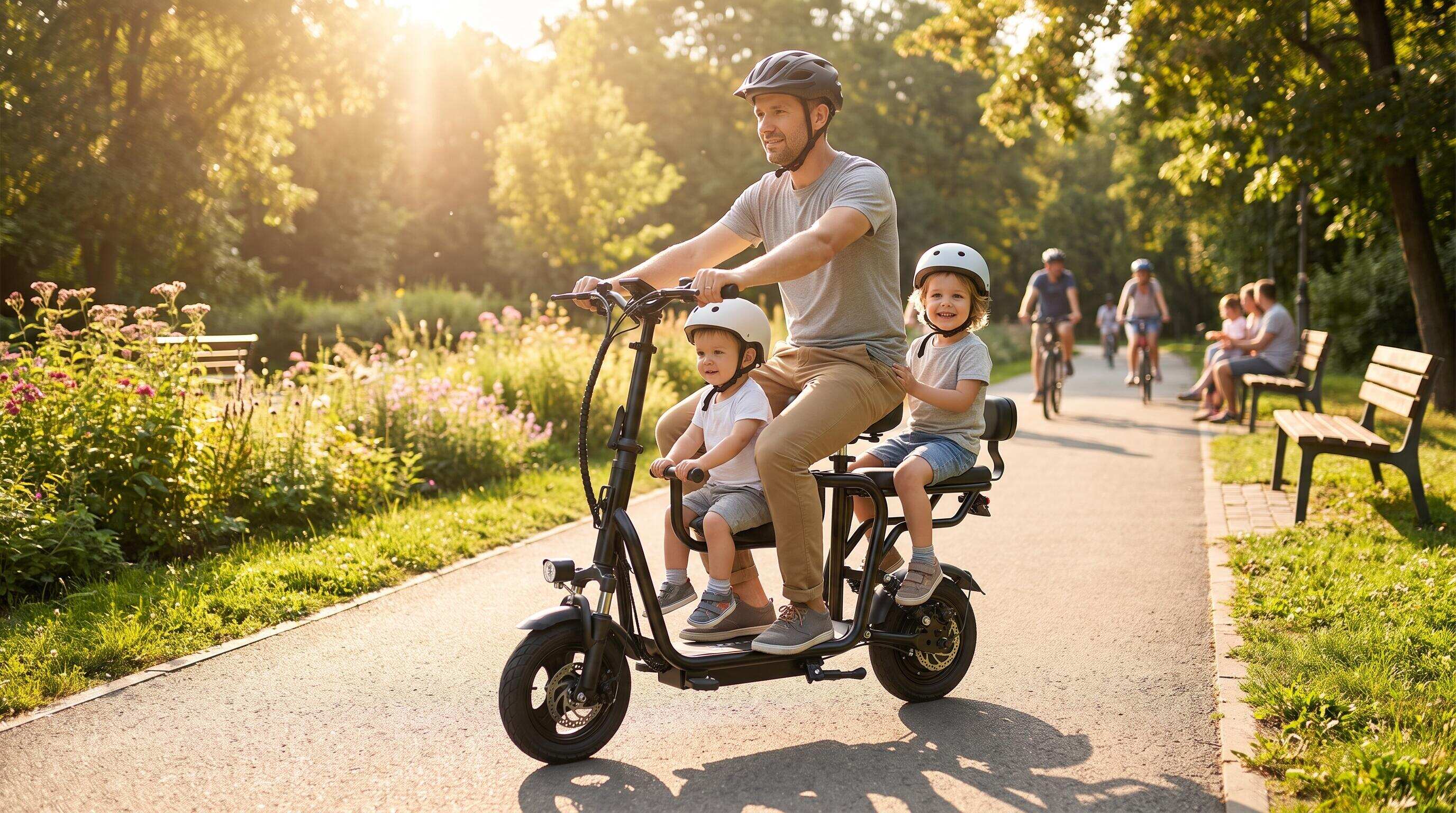
ALT: Parent on a 3-seat cargo e-bike with two helmeted children riding safely on a sunny paved family trail
Quick Comparison at a Glance
| Feature | Best For | Key Strength | Limitation |
|---|---|---|---|
| Front-loader cargo box | Keeping both kids visible and contained | Full child visibility, enclosed seating | Larger footprint, harder to store/park |
| Longtail dual rear seating | Side-by-side or tandem rear passengers | Familiar bike handling feel | Riders must check mirrors for rear passengers |
| Front seat + single rear seat | Mixed-age siblings with different needs | Flexibility, good weight distribution | Front seat affects steering sensitivity |
| Mid-drive motor | Hilly terrain, heavy loads | High torque, efficient at all speeds | Higher cost, more complex drivetrain |
| Hub motor (rear) | Flat terrain, budget-conscious families | Simple, low maintenance | Less efficient on climbs under full load |
| Hydraulic disc brakes | Any child passenger application | Consistent, modulated stopping | Higher cost, occasional bleed needed |
| Class 1 pedal-assist | Multi-use paths, new cargo riders | Broad trail access, controlled feel | No throttle for short boosts |
| Class 2 with throttle | Riders wanting occasional electric boost | Flexible assist options | Trail restrictions in some jurisdictions |
How to Choose the Right 3-Seat E-Bike Setup for Your Family
The right choice depends on two things above everything else: your children's ages and sizes, and your typical riding environment.
If your children are both toddler or preschool age and you ride primarily on flat, paved paths or neighborhood streets, a front-loader cargo bike with a box seating area gives you the most contained and parent-visible configuration. If your children are slightly older (and within the weight limits of rear child seats), a longtail cargo e-bike with dual rear seating is often more versatile and easier to handle in mixed traffic.
For families in hilly cities — think San Francisco, Seattle, or Denver — motor torque and braking quality should be near the top of your priority list. A mid-drive motor or a high-torque rear hub, paired with hydraulic disc brakes, makes the weight of two children manageable on climbs and descents without the anxiety of underpowered assist or mushy stopping.
A common misconception worth clearing up directly: many parents assume that any e-bike can become a family cargo bike by adding aftermarket child seats. This is not accurate. The frame, fork, and rear rack of a standard recreational or commuter e-bike are typically not engineered for the combined static and dynamic loads of two child passengers. Using them that way can compromise structural integrity in ways that are not visible until failure. Always start with a frame and platform specifically designed for family cargo use.
Budget is real, and there are meaningful differences in what different price points offer. The key is to prioritize the non-negotiable safety features — braking quality, child seat ratings, and frame payload certification — and accept compromise on secondary features like display sophistication or accessory integration. Eilleo Bike approaches this from a direct-to-consumer model that keeps family-capable e-bikes accessible without cutting corners on what actually keeps riders safe.
Finally, get hands-on before you commit if at all possible. Cargo e-bikes handle very differently from standard bikes, especially when loaded. Many local bike shops carry demo units, and an afternoon of test riding with your children's weight simulated (use a loaded backpack in the seats if the kids aren't present) will teach you more than any specification sheet.
Common Questions
Q1: How do I know if a cargo e-bike's frame is strong enough to carry two kids?
A cargo e-bike designed for two child passengers will have a specified total payload capacity from the manufacturer — this number includes rider weight, children's weight, and any cargo or accessories. Look specifically for this stated payload figure rather than estimating from the bike's general build. Frames from reputable cargo e-bike manufacturers are typically tested to standards that include dynamic load simulation, not just static weight. If a manufacturer does not publish payload ratings, treat that as a red flag.
Q2: Are 3-seat e-bikes legal to ride on bike paths in the United States?
Legality on bike paths depends on the e-bike's class (Class 1, 2, or 3) and the specific rules of the jurisdiction where you're riding. Class 1 bikes (pedal-assist only, up to 20 mph) are permitted on the widest range of paths, including most multi-use trails. Class 3 bikes face more restrictions. Additionally, some parks and trail systems have size or width restrictions that may apply to wider cargo bikes. Check local regulations before your first ride, and when in doubt, ride as a Class 1 bike regardless of what your bike is capable of.
Q3: How much does a quality 3-seat family e-bike typically cost, and is it worth the investment?
Quality cargo e-bikes configured for two child passengers currently range broadly in price, from relatively accessible options to premium European-made models at several times that cost. The investment is generally considered worthwhile when compared to the cost of additional car ownership, parking, or fuel over even a single year of active family use. Prioritize spending on structural integrity, braking quality, and certified child seating — those are where safety lives — and be flexible on features like display quality or brand cache.
Summary
Riding with two kids on a single e-bike is not only possible — when done with the right equipment and preparation, it is one of the most rewarding ways a family can move through their neighborhood, commute to school, or explore local trails together.
Three things matter most:
First, start with the right platform. A bike engineered specifically for multi-passenger family use — with the correct payload rating, stable frame geometry, and quality braking — is non-negotiable. Adding child seats to a standard e-bike is not a safe substitute.
Second, invest in certified child restraints and helmets. The harness system and helmet are the last line of protection if something unexpected happens. Treat this spending as essential, not optional.
Third, build your skills before you ride in traffic. Cargo e-bikes with two children handle differently than any bike you've ridden before. Practice in low-stakes environments first, build confidence progressively, and lower your speed settings until the loaded bike feels natural.
The family e-bike category is maturing quickly, and more accessible options are entering the market regularly. Doing this research now puts you ahead of that curve.
Explore a full range of affordable, dependable electric bikes built for real family use at the Eilleo Bike website — and find the model that fits your riding life.
Sources & Citations
- U.S. Consumer Product Safety Commission. "Bicycle Helmet Safety Standard (16 CFR Part 1203)".
https://www.cpsc.gov - U.S. Department of Transportation, Federal Highway Administration. "Electric Bicycle Classifications and State Regulations".
https://www.fhwa.dot.gov - ASTM International. "Standard Consumer Safety Specification for Bicycle-Mounted Child Seats and Related Safety Standards".
https://www.astm.org
Note: Standards may be updated; please check the latest official documents or consult professional advisors.


