

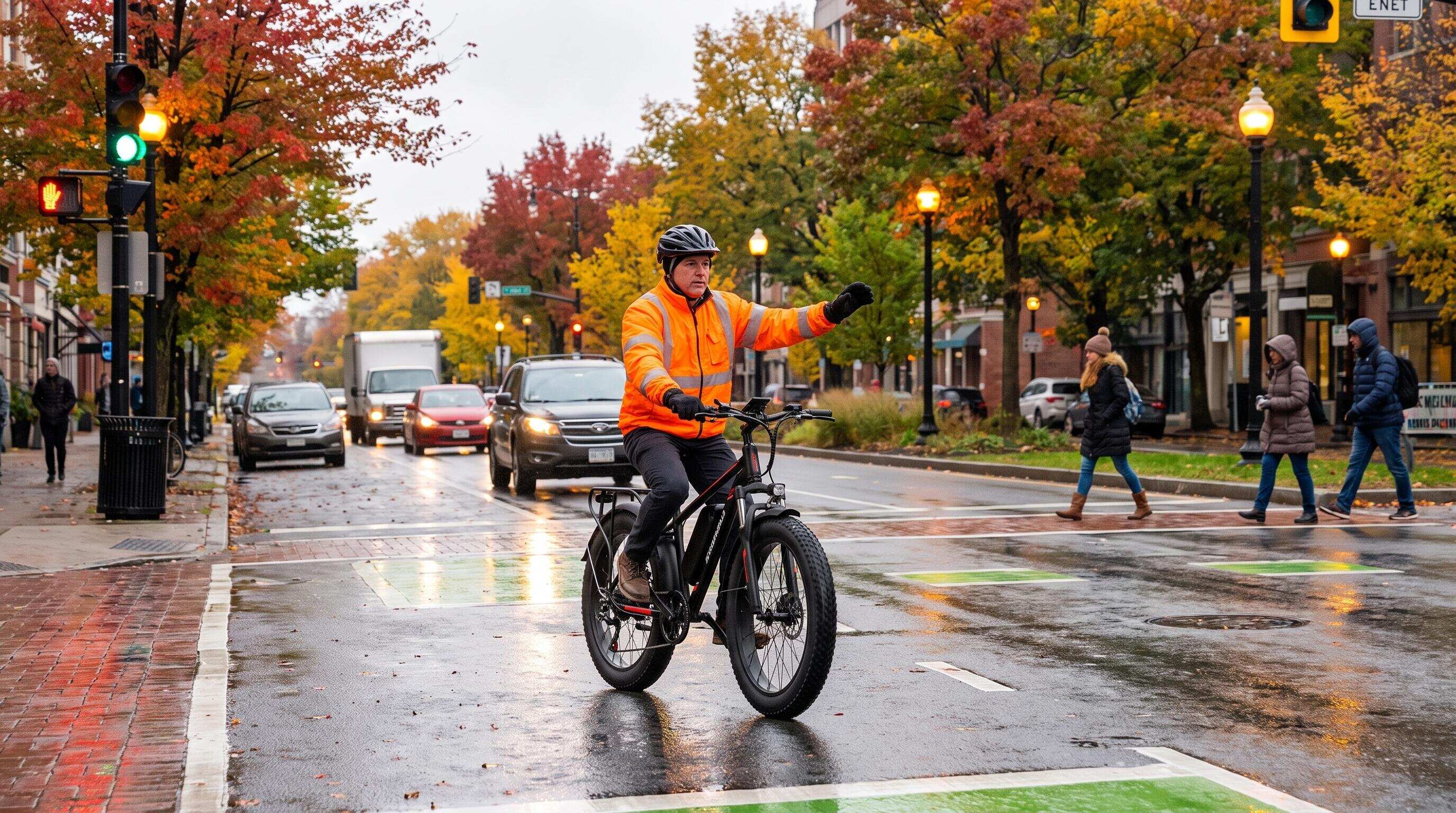
ALT: Rider safely navigating fall traffic on an electric bike through colorful autumn streets
Stay Safe This Fall: Your Complete Guide to Riding an E-Bike or Scooter in Traffic and on Shared Paths
Riding an e-bike or electric scooter in the fall is one of the most rewarding experiences you can have on two wheels — crisp air, stunning foliage, and roads that feel a little more open as summer crowds thin out. But autumn also brings its own set of hazards: wet leaves on bike paths, lower visibility as days shorten, and shared trail traffic that peaks during the weekend leaf-peeping season. Whether you're a teen commuting to school, a parent running errands on a cargo e-bike, or a weekend adventurer exploring local trails, this guide walks you through exactly what it takes to ride safely in traffic and on shared paths when the leaves start to fall. From gear prep to right-of-way etiquette, every step here is practical, actionable, and designed for real riders — not professional racers.
Before You Start: Prerequisites and Preparation for Safe Fall Riding
Safe fall riding starts well before you clip on your helmet. In our experience helping riders of all ages get comfortable on electric bikes and scooters, the single most consistent pattern we see is that preventable close calls happen because riders skipped the pre-ride checklist. Taking a few minutes before each ride — especially as conditions shift with the season — pays off enormously.
What you need before your first fall ride:
- A properly fitted helmet rated to current safety standards (CPSC certification at minimum for street riding)
- Front and rear lights, both for being seen and for seeing the road ahead
- Reflective gear or a high-visibility vest, especially for dawn and dusk rides
- A fully charged battery with enough range for your planned route
- Tires inflated to the manufacturer's recommended pressure (cold autumn air drops tire pressure)
- A working bell or horn for shared path use
- A basic understanding of your local e-bike and scooter laws (rules vary by state and municipality)
- Familiarity with your bike's motor assist levels and braking distance
Time and effort estimate: A thorough pre-ride safety check takes about five to ten minutes. The gear investment — lights, reflective accessories, quality helmet — is a one-time effort that pays dividends all season. If you're new to e-bikes, budget an afternoon to practice in a quiet area before heading into traffic.
Knowledge baseline: You don't need to be a cycling expert, but you should be comfortable with basic bike handling — starting, stopping, signaling, and looking over your shoulder without swerving. E-bikes and electric scooters accelerate faster than traditional bikes, so understanding your assist level before you hit a busy intersection is essential.
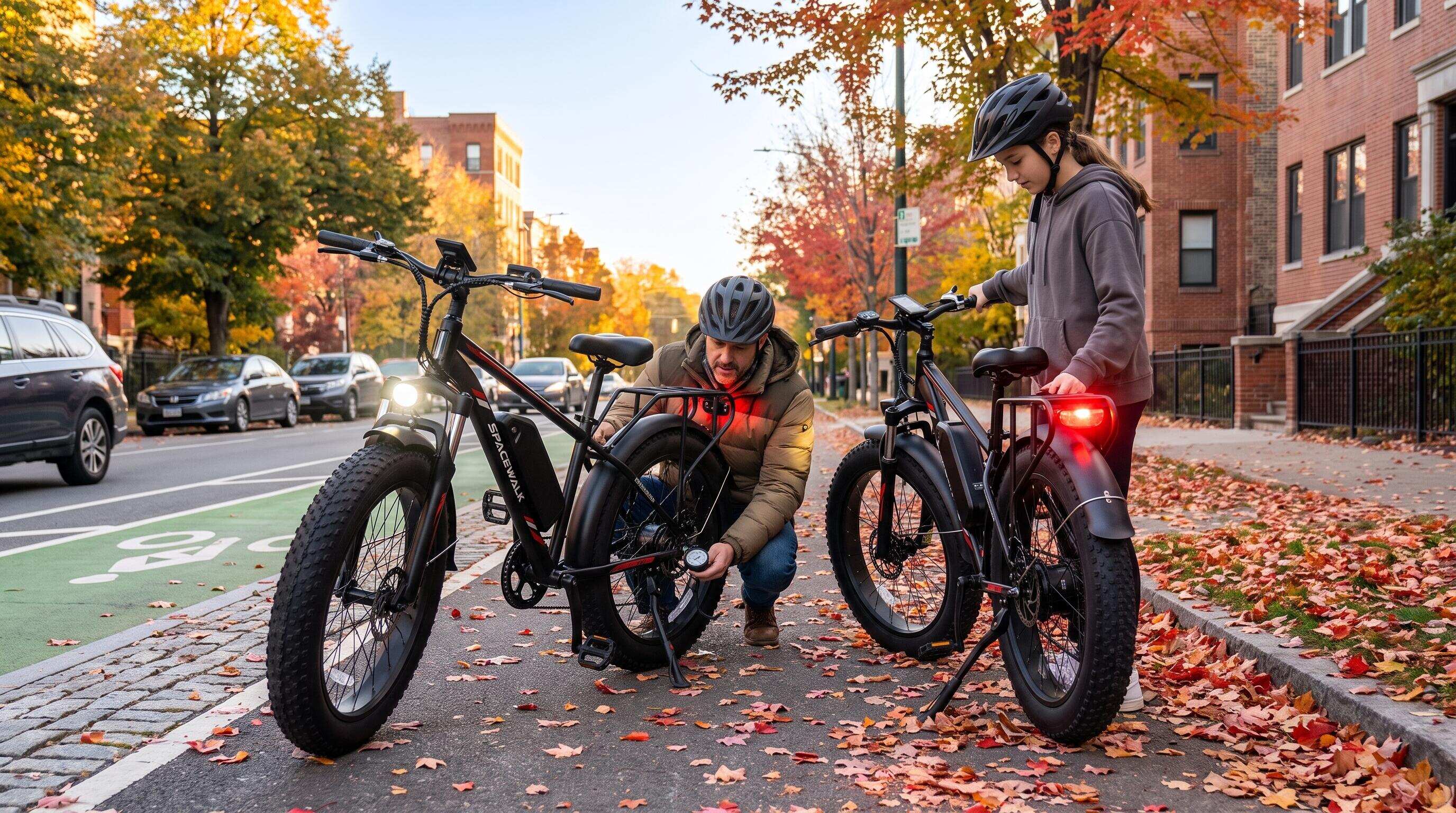
ALT: Parent and teen checking electric bike lights and tire pressure before a fall commute on shared paths and streets
Step-by-Step: How to Ride an E-Bike or Scooter Safely in Traffic and on Shared Paths This Fall
Step 1: Gear Up for Fall Conditions Specifically
Fall riding gear is distinct from summer or winter setups, and getting it right makes a real difference in both safety and comfort. Layered clothing that you can adjust as you warm up is key — you'll often start cold and end your ride sweating. More critically, visibility drops dramatically in autumn. Shorter days mean many commuters are riding in low-light conditions even during typical commuting hours. Wear bright outer layers and add reflective strips to your bike bag, helmet, and jacket.
Waterproof gloves are worth having on hand even if the forecast looks dry — wet leaves can create puddles in unexpected spots, and gloves also help you maintain a confident grip on your handlebars when temperatures dip. Fall-specific cycling glasses (clear or amber-tinted lenses) cut through the flat, diffuse light of overcast autumn days better than dark sunglasses.
Tip: Add a rear blinking light even for daytime riding. Studies cited by the National Highway Traffic Safety Administration (NHTSA) consistently show that conspicuity — how visible you are to drivers — is one of the highest-impact safety factors for cyclists in traffic.
Step 2: Inspect Your E-Bike or Scooter Before Every Fall Ride
A pre-ride inspection is non-negotiable in autumn. The season brings changing temperatures that affect battery performance, wet leaves that coat brake pads with debris, and roads that hide hazards under colorful foliage. Run through this quick inspection before each ride:
Check your tire pressure first — cold air causes pressure to drop, which affects handling and braking distance. Next, squeeze both brake levers firmly to confirm they engage smoothly and feel solid. Spin your wheels and look for any wobble or debris caught in the spokes. Turn on your lights and verify both front and rear are working. Finally, check your battery level and confirm your motor assist is responding correctly before you leave your driveway.
If you ride a fat-tire e-bike, the extra tire volume that makes these bikes so capable on loose terrain also means you need to be deliberate about pressure — run them too soft and you'll struggle to hold a straight line on wet pavement; too firm and you lose the grip advantage on slippery surfaces.
Tip: Keep a small, portable bike pump rated for your valve type in your bag. A quick top-up before riding in cold weather takes under two minutes and dramatically improves handling consistency.
Step 3: Master Your Positioning in Traffic
Proper lane positioning is the single most important traffic skill for e-bike and scooter riders. The safest place on most roads is not the far edge of the lane — it's the right third of the lane, far enough from the curb to avoid drain grates and door zones of parked cars, but close enough that you're not blocking faster traffic unnecessarily. This is called "taking the lane" when needed, and it's legally supported in most U.S. states for cyclists.
E-bikes and electric scooters can keep pace with urban traffic more effectively than traditional bikes, which actually makes lane positioning easier. Use your motor assist to maintain a consistent speed that matches the flow of traffic, reducing the urge drivers have to pass you in tight spaces. When approaching intersections, move to the center of the travel lane early to be clearly visible and to signal your intent to proceed straight or turn.
On roads with designated bike lanes, use them — but stay alert for right-turning vehicles crossing the lane at intersections. These "right hook" collisions are among the most common for cyclists, and fall brings increased distraction from drivers watching foliage rather than their mirrors.
Tip: Make eye contact with drivers when possible, especially at intersections and driveways. A brief moment of confirmed mutual awareness is worth more than assuming a driver has seen you.
Step 4: Navigate Shared Paths with Courtesy and Control
Shared paths — multi-use trails used by cyclists, pedestrians, joggers, dog walkers, and sometimes inline skaters — require a completely different mindset than road riding. The guiding principle is predictability: move in consistent, readable patterns so other path users can anticipate where you're going.
Slow down well before you reach pedestrians, especially groups, children, and people with dogs (leashes are invisible trip hazards at speed). Call out "on your left" or use your bell at least 50 to 100 feet before passing, then pass with generous clearance. On popular fall paths, it's common to encounter slow-moving family groups spread across the width of the trail — be patient, reduce speed, and only pass when you have a clear line and enough space.
E-bikes and electric scooters are faster than most path users expect, and the near-silent motor means people often don't hear you coming. Use your bell proactively and consistently — not as a "get out of my way" signal, but as a friendly advance notice. In our experience, a cheerful bell ring well in advance prevents the startled jump-and-swerve reaction that causes most shared-path incidents.
Tip: On heavily used fall trails, drop your motor assist to a lower setting to match the pace of the environment. Riding at full assist speed through a crowded autumn park is dangerous regardless of your skill level.
Step 5: Adapt Your Braking and Speed for Autumn Hazards
Wet leaves are the black ice of autumn cycling — they look harmless and are dangerously slippery. A single patch of wet, compacted leaves on a corner can drop your tires out from under you with almost no warning, especially if you're braking at the same time. The fix is simple but requires discipline: slow down before you reach corners on leaf-covered paths, not during them.
Apply your brakes in a straight line, before the hazard, and then release them as you navigate through. Avoid sudden hard braking on any slippery surface. If your e-bike or scooter has multiple brake types (disc brakes front and rear, for example), apply both evenly rather than grabbing the front brake alone, which can pitch you forward.
Puddles hiding under leaves can conceal potholes, roots, and edge drops. Approach unfamiliar puddles at low speed and be ready to absorb impact through your knees rather than your wrists. Fat-tire e-bikes handle these hazards better than narrow-tire urban bikes, but no tire is immune to a deep, hidden pothole at speed.
Tip: Ride at a speed that gives you comfortable stopping distance to a complete stop within your visible clear zone ahead. If you can't stop in time for something you can currently see, you're going too fast for conditions.
Step 6: Use Lights and Signals Every Single Time
Fall light changes fast. An afternoon ride that starts in full sun can end in near-darkness, especially after daylight saving time ends. Always have front and rear lights on your bike or scooter, and turn them on at the start of every ride — not just when it gets dark.
Hand signals are the other half of the communication equation. Signal every turn and lane change, even if it feels unnecessary. In traffic, a clear hand signal gives drivers valuable advance notice and helps establish you as a predictable, rule-following road user. E-bike riders in particular benefit from this because some drivers still aren't used to seeing pedal-assist bikes keeping pace with urban traffic.
For scooter riders, make your signals large and deliberate — extend your arm fully, hold the signal for several seconds, and complete your turn smoothly. A hesitant or incomplete signal is sometimes worse than none at all because it creates confusion.
Tip: If your ride regularly extends into low-light hours, invest in a rechargeable front light that mounts solidly and has a beam wide enough to illuminate the road surface ahead, not just to make you visible to others. Both functions matter.
Step 7: Know the Rules of the Road for E-Bikes and Scooters in Your State
E-bike and electric scooter laws in the United States vary significantly by state and local jurisdiction. Most states follow a three-class e-bike system (Class 1, 2, and 3) based on motor power and whether the bike has a throttle, and each class may have different rules about where it can be ridden — roads, bike lanes, or shared paths. Scooter regulations are even more varied, with some cities requiring helmets for all ages and others having minimum age requirements.
Before riding in traffic or on shared paths this fall, look up your state's specific rules. Your state's Department of Transportation website is a reliable starting point. Key things to check: maximum motor-assist speed allowed on bike paths, helmet requirements by age, whether your class of e-bike is allowed on trails in local parks, and any registration or licensing requirements for electric scooters.
Tip: If you're buying an e-bike or scooter for a teen, the local rules around minimum age and helmet requirements are non-negotiable. Make compliance part of the purchase conversation, not an afterthought.
Common Mistakes and Troubleshooting
| Symptom | Likely Cause | How to Fix |
|---|---|---|
| Skidding or sliding on corners | Wet leaves or damp pavement beneath loose debris | Slow down before corners, not during; brake in a straight line; reduce tire pressure slightly for better grip on fat-tire models |
| Near-miss with pedestrians on shared paths | Approaching too fast without warning | Drop assist level on busy paths; use bell proactively at least 50 feet before reaching walkers |
| Reduced battery range in cold weather | Lithium batteries lose efficiency in low temperatures | Warm up the battery indoors before riding; avoid leaving the e-bike outside in freezing temps for extended periods |
| Drivers not yielding at intersections | Poor rider visibility or unclear positioning | Add front and rear lights, wear high-vis gear, move to center of lane at intersections, make eye contact with drivers |
| Losing control over hidden potholes under puddles | Can't see road surface hazards beneath standing water | Reduce speed on unfamiliar roads; approach puddles with soft knees ready to absorb impact; favor known routes on wet days |
| Brake fade or sponginess | Debris on brake pads from wet leaves and mud | Clean brake pads and rotors after dirty rides; check pad wear and replace if worn |
Pro Tips for Better Fall E-Bike and Scooter Riding
Build route familiarity before conditions change. The best time to learn a new route is before the leaves fall and puddles form. Ride your planned commuting or recreation routes a few times in fair weather so you know where the drain grates, narrow sections, and tricky intersections are. When conditions deteriorate, you'll navigate on muscle memory rather than reactive guessing.
Communicate your presence through behavior, not just equipment. Lights and bells matter, but consistent, predictable riding behavior is what actually earns respect from drivers and fellow path users. Ride in a straight line, signal early, and avoid sudden movements. When drivers and pedestrians can read your intentions easily, they give you more space.
Treat your battery as a seasonal system. Lithium-ion batteries — the power source in virtually all modern e-bikes and electric scooters — are sensitive to cold. Performance drops measurably as temperatures fall, meaning your real-world range will be shorter on a cold October morning than it was in August. Build extra buffer into your route planning and recharge fully after every ride.
One common misconception: Many riders assume that because e-bikes are faster than traditional bikes, they're treated like motor vehicles under traffic law. In most U.S. states, low-speed Class 1 and Class 2 e-bikes follow the same rules as traditional bicycles — they belong in bike lanes, must yield to pedestrians on shared paths, and don't require registration or a motorcycle license. Always verify your local rules, but don't assume you need a license just because your bike has a motor.
Use your motor assist strategically, not maximally. Full assist all the time isn't always the safest setting. In busy pedestrian areas, crowded trail sections, or tricky descent situations, a lower assist level gives you finer speed control and keeps your braking distances manageable. Think of the assist levels as tools to match the environment, not just a way to go faster.
People Also Ask
Q1: How should I position myself when riding an e-bike in traffic?
Ride in the right third of the travel lane — far enough from the curb to avoid drain grates and car door zones, but close enough not to unnecessarily impede traffic. At intersections, move to the center of the lane to be clearly visible. E-bikes can generally maintain urban traffic speeds, which makes consistent lane positioning easier than on traditional bikes. The Federal Highway Administration supports "taking the lane" as a recognized and safe practice for cyclists in appropriate situations.
Q2: Are wet leaves on bike paths actually dangerous for e-bike riders?
Wet leaves on paved paths and roads are genuinely hazardous and should be treated with the same caution as black ice. Compressed, wet leaf matter has very low friction, especially when combined with pavement that hasn't fully dried. The danger increases on corners where riders may be leaning and braking simultaneously. Reduce your speed before leaf-covered sections, brake in a straight line, and choose a line through corners that avoids the heaviest leaf accumulation whenever possible.
Q3: How long does it take to learn safe e-bike riding habits for traffic and shared paths?
Most riders build solid foundational habits within a few practice sessions — typically two to five rides in low-traffic or quiet path environments before moving to busier settings. The skills that take longest to develop are reading traffic flow and timing intersections confidently. Budget a few weekends of deliberate practice if you're new to riding in traffic. Teens and first-time riders benefit particularly from practicing hand signals, controlled braking, and speed management before venturing into shared public spaces.
Key Takeaways
Safe fall e-bike and scooter riding comes down to three core practices: prepare your gear and bike for changing conditions, position yourself predictably in traffic and on shared paths, and adjust your speed and riding style to match autumn hazards like wet leaves, low light, and heavier trail traffic.
The gear side is straightforward — lights, reflective layers, a properly fitted helmet, and a well-maintained bike. The behavioral side takes a little more intentional practice: consistent signaling, proactive bell use, early braking, and choosing speeds that give you genuine stopping distance. None of this is complicated, but it does require making these habits automatic rather than situational.
Fall is genuinely one of the best times of year to ride. The temperatures, the scenery, and the feel of the road make every commute and weekend adventure more memorable. A little preparation and a few good habits are all that stand between you and a fantastic fall riding season.
Ready to find your perfect ride? Eilleo Bike offers a wide lineup of affordable fat-tire, cargo, commuter, and electric scooter models designed for every rider — from curious teens to active families and weekend adventurers. Visit the Eilleo Bike website today to explore the full collection and discover the e-bike that fits your lifestyle and budget.
References & Further Reading
- National Highway Traffic Safety Administration (NHTSA). "Bicycle Safety and Rider Visibility Guidelines".
https://www.nhtsa.gov - Federal Highway Administration (FHWA), U.S. Department of Transportation. "Bicycle and Pedestrian Program — Lane Positioning and Shared-Use Path Design Guidance".
https://www.fhwa.dot.gov - U.S. Consumer Product Safety Commission (CPSC). "Bicycle Helmet Safety Standards and Requirements".
https://www.cpsc.gov
Note: Standards and regulations may be updated; please check the latest official documents or consult professional advisors for current requirements in your state.


