

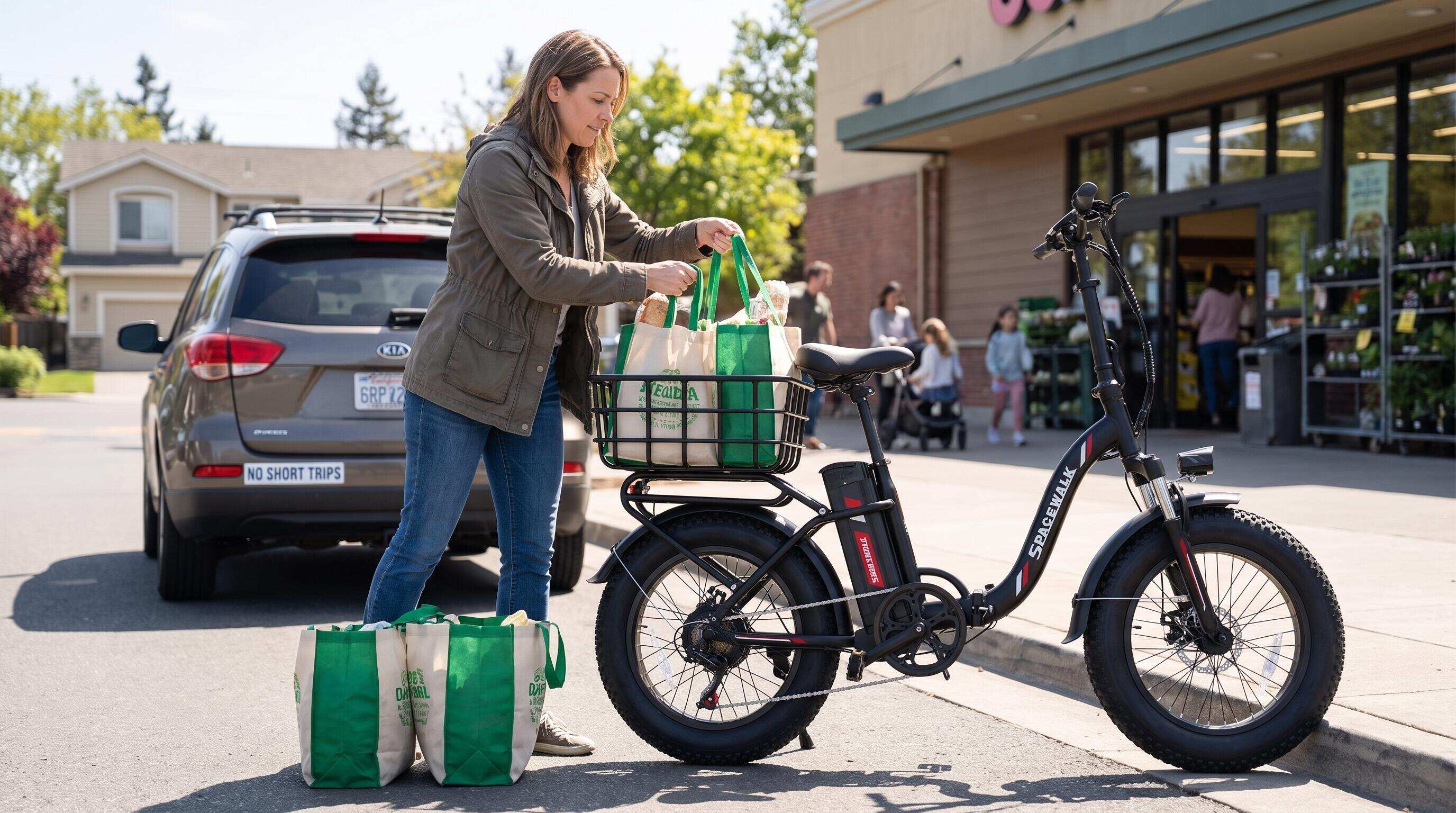
ALT: Electric bike parked beside a car, comparing green transportation options for eco-conscious families
Is Riding an E-Bike Actually Greener Than Owning a Second Car?
The short answer is yes — by a significant margin. An e-bike produces a fraction of the lifecycle carbon emissions of even the most fuel-efficient conventional car, and in most American households, replacing a second car with an e-bike for everyday trips can eliminate thousands of pounds of CO₂ per year. That's not marketing spin; it's the conclusion backed by transport researchers and borne out by the riding patterns we consistently observe among the families and commuters who make the switch.
This article breaks down the environmental numbers in plain language — covering manufacturing impact, energy consumption, emissions per mile, and total lifecycle footprint — so you can make a genuinely informed decision rather than guess. Along the way, we'll flag the scenarios where the math is most favorable, and the situations where the comparison gets more complicated, because honesty about both is what builds real trust.
When This Comparison Actually Applies to You
Applicable Scenarios:
- You're considering buying (or already own) a second household vehicle primarily used for short trips — grocery runs, school pickups, quick errands under 15 miles each way
- You commute in an urban or suburban environment where e-bike infrastructure (bike lanes, racks, charging points) is reasonably accessible
- You're a teen or young adult looking for independent transportation and want to understand the environmental case alongside the cost case
- Your family wants to reduce its carbon footprint without sacrificing convenience or reliability
Not Applicable / Cautions:
- If your second car is your only means of reaching work in a rural area with no safe cycling routes, e-bike substitution isn't realistic for all trips — though it can still offset some car use
- If your primary concern is hauling very heavy loads or transporting multiple passengers long distances, an e-bike alone won't cover every need — though cargo e-bikes close that gap more than most people expect
Why People Are Asking This Question Right Now
Transportation is the single largest source of greenhouse gas emissions in the United States, a finding consistently reported by the U.S. Environmental Protection Agency. Within that category, personal passenger vehicles — especially the second or third car sitting in American driveways — account for a disproportionate share of total household emissions. At the same time, e-bike adoption has accelerated sharply, with millions of units now sold annually in the U.S. market. That collision of rising climate consciousness and falling e-bike prices has produced one very practical question at kitchen tables across the country: could we just get rid of that second car?
The pattern we consistently see among first-time e-bike buyers is that the environmental question comes bundled with a financial one. People aren't idealists detached from practicality — they want to know whether the green choice is also the smart choice. It almost always is, and the numbers tell a compelling story.
According to a widely cited study covered by Electrek, electric bicycles produce dramatically lower lifecycle emissions than electric cars — let alone gas-powered ones — because they require far less raw material, far less energy to manufacture, and consume very little electricity per mile of travel. The research found that e-bikes are, on a per-mile basis, one of the most carbon-efficient forms of motorized transport ever measured.
The conversation has also shifted because e-bike technology has matured. Models now cover everything from fat-tire all-terrain bikes to cargo haulers capable of replacing a car for family errands. The old objection — "but I can't carry groceries on a bike" — has largely evaporated for anyone who's seen a modern cargo e-bike in action.
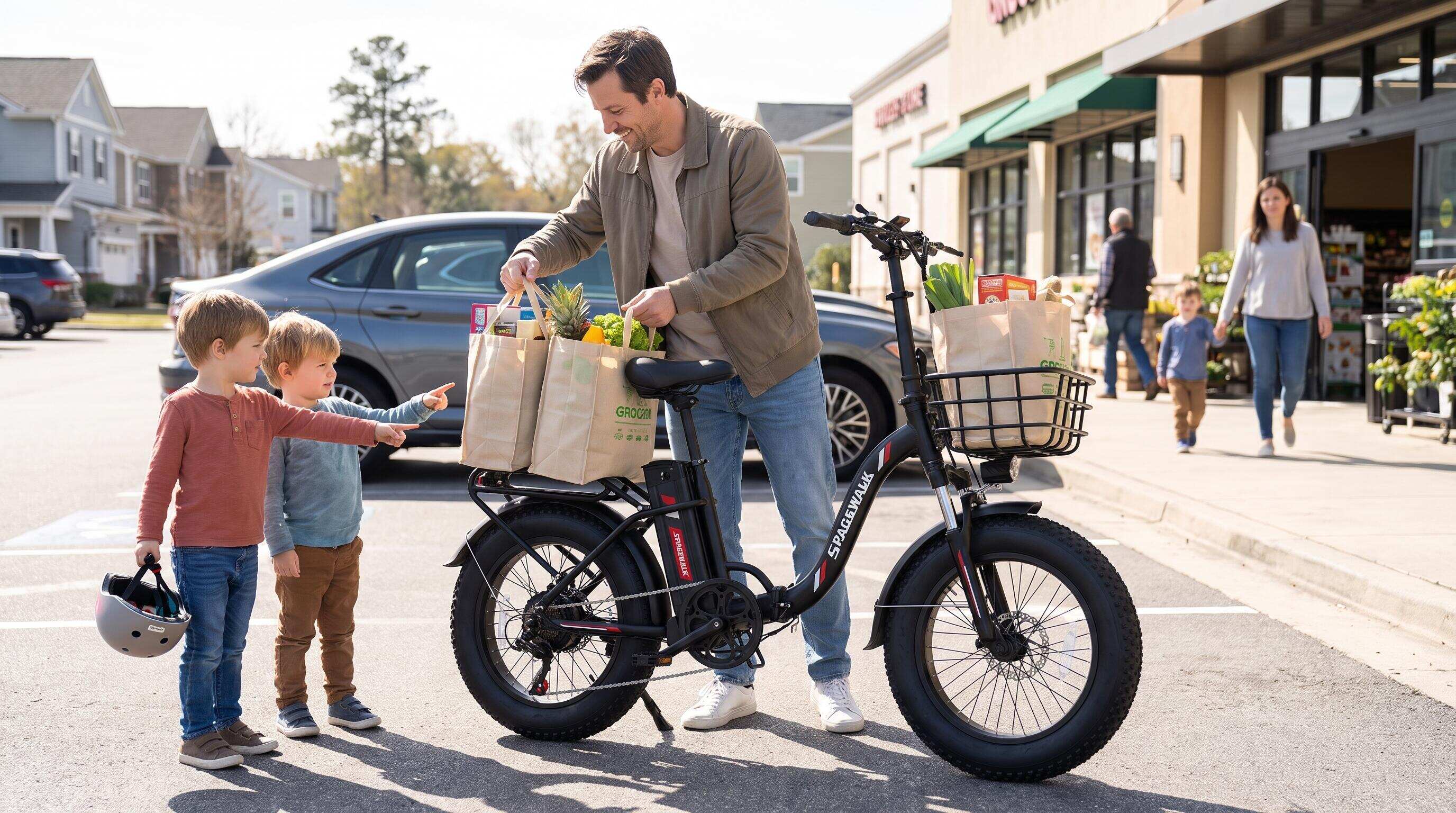
ALT: Parent loading a cargo e-bike with grocery bags, demonstrating how e-bikes replace short car trips for families
Breaking Down the Numbers: Manufacturing, Energy, and Lifecycle Emissions
Three Ways to Measure Whether an E-Bike Is Greener
Step 1: Compare Manufacturing Emissions
Manufacturing a conventional car requires enormous quantities of steel, aluminum, plastics, glass, rubber, and — increasingly — large battery packs for electric vehicles. The embodied carbon in vehicle production is substantial before the car turns a single wheel. An e-bike, by contrast, uses a much smaller battery, a lightweight aluminum or steel frame, and modest amounts of electronic components. The manufacturing footprint of an e-bike is qualitatively far smaller — researchers who have studied lifecycle assessments consistently place e-bike production emissions at a small fraction of automobile manufacturing. This alone gives the e-bike a major head start in any environmental comparison, and it's a head start that matters even before you consider fuel or electricity use.
Step 2: Calculate Energy Use Per Mile
Once you're riding, the efficiency gap widens dramatically. A conventional gasoline car converts only a portion of the energy in its fuel into forward motion; the rest is lost as heat. An electric motor on an e-bike is highly efficient, and the bike itself weighs so little that moving it requires minimal energy in the first place. Per mile traveled, an e-bike consumes a tiny fraction of the energy of a car — electric or gasoline. PeopleForBikes research on e-bike travel patterns has documented that e-bikes expand the range of trips people take by bike, meaningfully displacing car miles rather than just replacing walking or traditional cycling. More displaced car miles means more emission savings stacking up every single week.
Step 3: Account for the Electricity Source
One nuance worth understanding: an e-bike's real-world emissions depend partly on how your local grid generates electricity. If your utility relies heavily on coal, the well-to-wheel emissions per mile are higher than if you live in a state with a high share of renewables. Even on a coal-heavy grid, however, e-bikes still outperform gasoline cars on emissions per mile — the efficiency advantage is that large. And as the U.S. grid continues to add renewable capacity, every e-bike charged today becomes cleaner over time without any change on the rider's part.
Comparing Transportation Options Across Key Environmental Dimensions
The table below presents a qualitative comparison based on the research literature and established lifecycle assessment methodology. Because grid mixes, vehicle models, and riding patterns vary, exact numbers will differ by situation — but the directional picture is clear and consistent.
| Comparison Dimension | Gasoline Car (Second Vehicle) | Battery Electric Car | E-Bike |
|---|---|---|---|
| Manufacturing carbon footprint | High (large battery, heavy materials) | Very high (large battery pack) | Low (small battery, minimal materials) |
| Energy consumption per mile | High | Moderate | Very low |
| Emissions per mile (average U.S. grid) | High | Low to moderate | Very low |
| Total lifecycle emissions | High | Moderate | Very low |
| Emissions improvement as grid greens | None (burns gasoline) | Yes | Yes (already minimal) |
| Infrastructure and parking footprint | Large | Large | Minimal |
Where the Environmental Case Gets Even Stronger — and Where It Gets Complicated
The strong case: short urban and suburban trips. The vast majority of second-car trips in American households are short — often under five miles each way. These short trips are the worst-case scenario for a gasoline car's emissions profile, because cold-engine starts and stop-and-go driving reduce fuel efficiency sharply. They are, simultaneously, the ideal scenario for an e-bike: manageable distances, no range anxiety, and conditions where the bike's low rolling resistance and efficient motor shine. In our experience working with families making this switch, the short-trip substitution rate is high and the satisfaction is immediate.
The cargo and kid-hauling case. Families often cite hauling kids or heavy loads as the reason they can't ditch the second car. Modern cargo e-bikes have upended this objection. A well-designed cargo e-bike can carry a meaningful load — groceries, a child in a front or rear seat, sports gear — transforming the family errand run. For school pickups and grocery trips, a cargo e-bike genuinely can replace the second car for most journeys. Eilleo Bike's cargo e-bike lineup is purpose-built for exactly this kind of practical, everyday utility, making the green choice also the convenient choice.
The complicated case: long rural commutes. If your second car is doing a 40-mile highway commute each way, an e-bike is not a like-for-like replacement for that specific trip — range, weather exposure, and safety on high-speed roads all present real constraints. The honest answer here is that an e-bike can still offset a meaningful portion of a household's car use even when it can't replace all of it. Replacing three out of five weekly car trips with e-bike trips produces real, cumulative emission savings.
A misconception worth addressing: "electric cars are already green enough." Battery electric vehicles are significantly cleaner per mile than gasoline cars, but their manufacturing emissions — especially from large battery packs — are substantially higher than for e-bikes. A person choosing between a second BEV and an e-bike for primarily short-trip use is still making a meaningful environmental choice in favor of the e-bike. According to analysis highlighted by PeopleForBikes, e-bike adoption has the potential to displace a substantial volume of car miles nationally, with cascading benefits for urban air quality, road congestion, and carbon totals.
Another real-world complication: "I'll just not ride it." An e-bike that sits in the garage because it's inconvenient or intimidating doesn't replace any car trips. This is a practical risk we've seen, and it's why choosing the right type of e-bike for your actual riding context matters enormously. A fat-tire e-bike for someone who wants to ride on mixed terrain, a compact urban e-bike for a city commuter, a cargo model for a family hauling kids — matching the bike to the rider's life is what turns environmental potential into actual emission reductions.
Advanced Considerations: Edge Cases, Misconceptions, and the Broader Picture
The battery disposal question. A common objection to e-bikes (and EVs) is battery end-of-life: what happens when the lithium battery needs replacement? It's a fair concern. E-bike batteries are much smaller than car batteries, meaning the recycling and disposal challenge is proportionally smaller. Battery recycling infrastructure is expanding, and the lifecycle analyses that show e-bikes as dramatically cleaner than cars already account for manufacturing and disposal impacts. The net environmental picture remains strongly favorable for e-bikes.
Embodied emissions in the car you already own. Here's a nuance that changes the math for some households: if you already own a second car, its manufacturing emissions are already "spent." Selling the car and replacing those trips with an e-bike saves operating emissions from that point forward, which are substantial — but you don't "un-do" the manufacturing footprint. The environmental argument is strongest when you're deciding whether to buy a new second car versus an e-bike. If you're deciding whether to retire an existing car, the ongoing operating savings are still real and significant over time.
E-bikes versus public transit. In cities with good transit, well-maintained buses and rail are also very low-emission options. E-bikes and transit often complement each other — an e-bike covers the "last mile" that makes transit more practical, and many transit systems allow e-bike parking or even folding e-bike carriage. The comparison with a second car, however, is where e-bikes show their most compelling advantage.
The "numbers for this year" framing. The emissions intensity of the U.S. electric grid changes year over year, and the trend is toward lower carbon intensity as renewables expand. This means that the environmental case for e-bikes — already strong — improves passively as the grid gets cleaner, without requiring any action from the rider. Buying an e-bike today is a decision whose environmental benefit compounds over time.
Questions & Answers
Q1: How do e-bike emissions compare to a gasoline car on a per-mile basis?
E-bikes produce dramatically fewer emissions per mile than gasoline cars. Because an e-bike is so lightweight and its motor is highly efficient, it consumes a tiny amount of electricity to move a rider — even on a moderately carbon-intensive U.S. electric grid. Lifecycle research consistently finds that e-bikes are among the lowest-emission motorized transport options available, outperforming even electric cars when manufacturing impacts are included. The gap is large enough to hold across virtually all U.S. grid mixes.
Q2: Is a cargo e-bike really capable of replacing a second car for family errands?
For most short-to-medium family errands — grocery runs, school pickups, trips to the park or sports practice — a cargo e-bike is a genuine and practical substitute. Modern cargo e-bikes are designed to carry meaningful loads and accommodate child passengers, turning what felt like a car-only job into a bikeable one. The key is realistic trip assessment: a cargo e-bike handles the majority of second-car trips for most families, though very long distances or adverse weather will still occasionally call for a car.
Q3: How long does it take for an e-bike to "pay back" its manufacturing emissions compared to a car?
Because e-bike manufacturing emissions are so much lower than car manufacturing emissions, the environmental payback period — the point at which the e-bike has offset the emission difference compared to a new car — is short. Researchers studying e-bike lifecycle assessments have found payback measured in months of regular use rather than years, particularly when the e-bike is displacing gasoline vehicle miles. The exact timeline varies with riding frequency, local grid mix, and the type of car being replaced, but the directional answer is: the payback is fast.
Wrapping Up
The environmental case for replacing a second car with an e-bike is not a hopeful estimate — it is well-supported by lifecycle assessment research and consistent with what we observe among riders making this transition. Three points stand out above everything else.
First, e-bikes have a dramatically lower manufacturing and operating carbon footprint than any passenger car, gasoline or electric. The difference is large enough to hold across virtually all real-world conditions.
Second, the use case matters enormously. E-bikes are most effective as second-car replacements for the short-to-medium trips that dominate most American household driving patterns. For those trips, the substitution is both practical and environmentally powerful.
Third, the right bike for your life is the one you'll actually ride. A fat-tire model for mixed terrain, a cargo bike for family hauling, an urban commuter for daily rides to work — matching the bike to your specific context is what converts environmental potential into real, accumulated emission savings.
If you're weighing whether to buy a second car or explore an e-bike instead, the numbers favor the bike. The next step is finding the model that fits your riding style, your family's needs, and your budget — and then getting out and riding it.
Ready to find your perfect ride? Eilleo Bike offers a full lineup of affordable e-bikes and electric scooters — from fat-tire and dirt bikes to cargo haulers and urban commuters — designed to fit every rider and lifestyle. Visit the Eilleo Bike website today to explore the latest models, compare features, and take the first step toward an easier, greener, and more exhilarating way to ride.
Sources
- Electrek. "New study suggests electric bicycles are much better than electric cars."
https://electrek.co/2019/07/08/study-electric-bicycles-better-than-electric-cars/ - PeopleForBikes. "Estimating the Effect of E-Bikes on Person Miles Travelled."
https://www.peopleforbikes.org/reports/the-e-bike-potential-estimating-the-effect-of-e-bikes - U.S. Environmental Protection Agency. Greenhouse Gas Emissions from Transportation.
https://www.epa.gov
Note: Standards and data may be updated; please check the latest official documents or consult professional advisors.


