

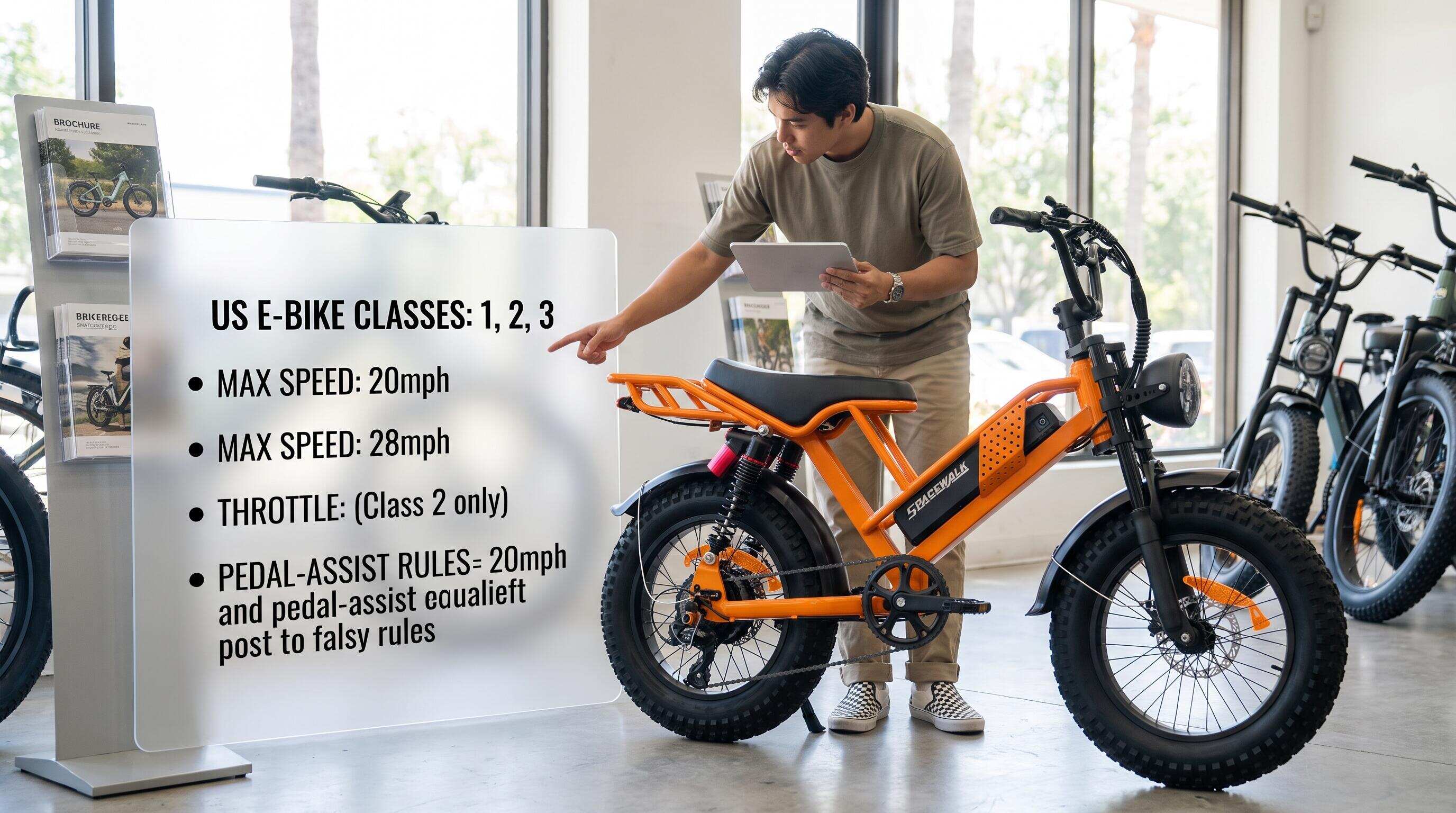
ALT: New rider learning e-bike class differences before buying first electric bike in the US
Why Your E-Bike Class Matters More Than You Think
The single most important question new electric bike riders ask is: "Which class of e-bike do I actually need?" The direct answer is this — in the US, e-bikes are divided into three federally recognized classes based on how their motor assists and what speeds they reach, and choosing the wrong class can mean getting turned away from your favorite trail, facing unexpected legal restrictions, or simply ending up with a bike that doesn't match how you actually ride.
This topic deserves a close look right now because the e-bike market is growing at a remarkable pace. More families, teens, and daily commuters are buying their first electric bikes than ever before, and a pattern we consistently see at Eilleo Bike is that new riders often focus almost entirely on price and looks — and then discover too late that the class they chose is incompatible with their local path, school campus, or trail system. Getting the class decision right from the start saves you headaches, money, and a lot of frustrating surprises.
The Three E-Bike Classes: Where They Came From and Where Things Stand Today
E-bike classification in the United States is a framework that is defined at the state level but broadly follows a three-tier model developed through collaboration between industry groups and legislators over the past decade. The People For Bikes organization was instrumental in promoting this standardized classification system, and today the majority of US states have adopted some version of it — making it the practical standard riders and retailers work from.
The core idea is simple: the faster and more powerful a motor-assisted bike is, the more carefully its use needs to be regulated to keep riders and pedestrians safe. Here is how the three classes break down:
- Class 1 e-bikes use pedal-assist only — the motor helps you only when you are pedaling — and the assist cuts off once you reach 20 mph. These bikes have no throttle.
- Class 2 e-bikes also have a top assisted speed of 20 mph but add a throttle, meaning the motor can propel the bike even if you stop pedaling.
- Class 3 e-bikes use pedal-assist (and sometimes a throttle, depending on state law) and allow motor assistance up to 28 mph, making them the fastest of the three classes.
Per the framework adopted by most states, Class 1 and Class 2 bikes are generally treated similarly for access purposes, while Class 3 bikes face more restrictions — particularly on multi-use trails and bike paths shared with pedestrians. At Eilleo Bike, we see this distinction come up constantly when customers ask about riding on local greenways, school paths, or national park trails.
It is also worth noting that this three-class system applies specifically to electric bikes — defined as bicycles with fully operable pedals and an electric motor that assists rather than replaces human power, with a motor output generally at or below 750 watts. Vehicles that exceed these parameters enter scooter, moped, or motorcycle territory and face different licensing and registration requirements entirely.
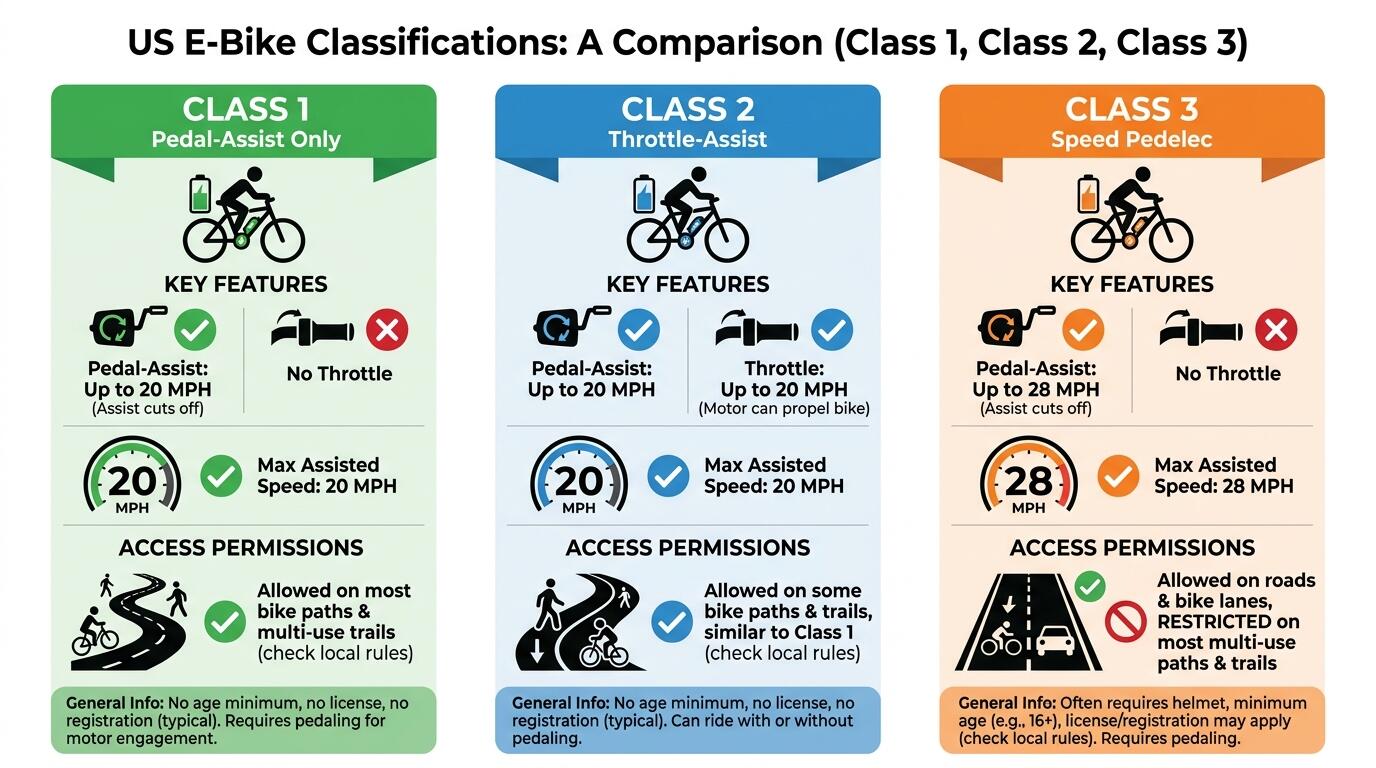
ALT: Comparison chart showing Class 1, Class 2, and Class 3 e-bike motor assist speeds and throttle features for US riders
How Each Class Works — and Why It Changes Everything About Your Ride
Understanding what actually happens mechanically and legally within each class is what separates a confident buying decision from a frustrated return trip to the shop.
Class 1: The Trail-Friendly, Low-Key Workhorse
Class 1 e-bikes are pedal-assist only, with no throttle and a 20 mph assist cutoff. Because the motor only activates when you pedal, these bikes feel the most like a traditional bicycle — just with a helpful boost when you hit a hill or start to tire. The payoff for that natural feel is broad access: Class 1 bikes are permitted on the widest range of trails, bike paths, and routes in the US, including many mountain bike trails that explicitly exclude higher classes.
For families with kids who ride on shared-use paths, or for recreational riders who want to explore greenways and rail trails without worrying about signage, Class 1 is often the smartest entry point. The riding experience is intuitive for beginners, and the absence of a throttle actually encourages more physical engagement — something parents often appreciate when choosing a bike for a teenager.
Class 2: The Flexible Everyday Rider
Class 2 e-bikes keep the same 20 mph speed cap but add a throttle, giving riders the option to let the motor do all the work without pedaling. This single feature makes Class 2 bikes dramatically more versatile for real-life use. Think about riding to work in dress clothes and not wanting to arrive sweaty — a throttle lets you cruise without effort whenever you need to. Think about a rider with a joint condition who needs occasional fully motorized movement. Think about carrying a heavy cargo load uphill.
A pattern we consistently observe across the riders who come to Eilleo Bike for guidance is that Class 2 is often the sweet spot for first-time buyers who want flexibility without the legal complexity of Class 3. Most states that follow the three-class framework allow Class 2 bikes on the same routes as Class 1, so you gain capability without meaningfully losing access.
Class 3: Speed-First for the Committed Commuter
Class 3 e-bikes provide pedal-assist up to 28 mph — a significant jump from the 20 mph ceiling of the lower classes. That extra speed matters enormously for urban commuters covering longer distances or navigating roads where keeping pace with traffic is a safety issue. Riders who commute on busy city streets or need to cover several miles quickly often find that 28 mph assist changes everything about the practicality of replacing a car trip.
The trade-off is access. According to the framework understood by most state transportation departments, Class 3 bikes are typically restricted from multi-use pedestrian paths and many recreational trails. In some states, Class 3 riders must be at least 16 years old and may be required to wear a helmet regardless of age. Before buying a Class 3 bike, it is essential to check your specific state and local regulations — what is legal in one county may be prohibited in the next.
The Dirt Bike and Off-Road Question
A common question we hear is where electric dirt bikes fit into this picture. The honest answer is that many off-road electric bikes — including the kind of fat-tire and dirt-style bikes that Eilleo Bike offers for outdoor enthusiasts — are designed primarily for off-road use on private land or designated off-road trails, rather than for on-road classification under the Class 1/2/3 framework. These bikes may have motor outputs or design features that place them outside the standard e-bike classification entirely, and they should be ridden according to the rules of the specific land or trail system where you use them.
Choosing Your Class: A Practical Comparison
Support your decision with this side-by-side breakdown of what each class does and does not offer:
| Perspective / Approach | Strengths | Trade-offs | Best Fit |
|---|---|---|---|
| Class 1 (Pedal-Assist, 20 mph) | Widest trail and path access; natural ride feel; beginner-friendly | No throttle option; slower top assisted speed | Recreational trail riders, families, beginners, teens |
| Class 2 (Throttle + Pedal-Assist, 20 mph) | Throttle flexibility; same access as Class 1 in most states; great for commuting | Slightly heavier battery usage when throttling constantly | First-time buyers, commuters wanting flexibility, riders with physical limitations |
| Class 3 (Pedal-Assist, 28 mph) | Fastest legal assist speed; ideal for longer urban commutes; road-confident | Restricted from many shared paths; age minimums in some states; requires more legal research | Experienced commuters, adults covering longer distances, road riders |
| Off-Road / Fat-Tire E-Bikes | Built for terrain; high fun factor; not bound by road classification | Not street-legal in classification terms; terrain-specific | Outdoor adventurers, teens on private land, trail riders |
As you review this table, note that "best fit" is not just about speed preference — it is about the specific routes you plan to ride. A Class 3 bike is not automatically better than a Class 1 just because it goes faster; if your local trail system bans Class 3 bikes, that speed advantage becomes a liability.
It is also worth noting that state laws vary. different states have adopted these classifications with different nuances, and some states have yet to fully codify all three classes in their traffic codes. Checking your specific state's department of motor vehicles or transportation website before buying is a straightforward step that saves real-world frustration.
Where E-Bike Classes Are Heading — and What It Means for You
The e-bike classification landscape in the US is continuing to evolve. More states are actively aligning their laws with the three-class model, and federal agencies have begun paying closer attention to e-bike safety standards, particularly for younger riders. The overall direction is toward greater standardization — which is good news for buyers, because it means the class system you learn today is increasingly likely to apply wherever you ride across the country.
For everyday riders, a few implications stand out. First, trail access rules are becoming more consistent — many trail systems that previously had blanket bans on e-bikes are now distinguishing between classes, opening their doors to Class 1 and Class 2 riders while keeping Class 3 bikes on the road. Second, the push for helmet requirements and age minimums for Class 3 is gaining traction in more states, which is relevant for families buying bikes for teenagers. Third, the off-road and fat-tire segment continues to grow outside the traditional classification framework, giving outdoor enthusiasts more powerful and capable options that simply operate in a different regulatory universe.
From the Eilleo Bike perspective, this trajectory reinforces a piece of advice we give to nearly every new rider: buy for the riding you will actually do, not the riding you imagine doing in a best-case scenario. A Class 2 bike that lets you commute comfortably and hop on a local trail on weekends will serve most everyday riders better than a Class 3 bike that technically gets restricted from half the routes they want to use.
Actionable takeaways from this analysis:
- Research your state's specific e-bike laws before you buy — not after.
- Identify the primary routes and surfaces you will ride on, and check what class is permitted there.
- Consider who else in your household might ride the bike; a Class 1 is often the safest multi-rider choice for families with teens.
- If urban speed and longer commutes are your priority, Class 3 is worth the added research into local regulations.
- For off-road and adventure riding, look at fat-tire and dirt-style options that are built for terrain rather than road classification.
People Also Ask
Q1: How do I find out which e-bike class is legal on my local trails?
The most reliable approach is to check directly with the managing agency of the trail — whether that is a city parks department, a county transportation authority, or a national forest service office. Many trail systems now post their e-bike policies on their websites, and they typically use the Class 1/2/3 terminology. Your state's department of transportation website is another solid starting point for understanding the baseline rules in your area.
Q2: Are Class 3 e-bikes legal for teenagers to ride in the US?
Class 3 e-bikes are subject to age restrictions in a number of states, with many setting a minimum age of 16 for Class 3 operation. Some states also require helmets for all Class 3 riders regardless of age. Class 1 and Class 2 bikes generally have fewer age-related restrictions, making them a more straightforward choice for teen riders. Always verify the specific rules in your state before purchasing a Class 3 bike for a young rider.
Q3: Does a higher e-bike class mean a better or more expensive bike?
Not necessarily. Class designation describes the motor's behavior and speed limit — it is not a quality rating. A well-built Class 1 or Class 2 bike can be mechanically superior to a poorly built Class 3 bike. Price is driven by components like the motor, battery capacity, frame material, and braking system, not by class alone. Many affordable, high-quality e-bikes fall in the Class 2 range and offer excellent value for everyday riders without the legal complexity of Class 3.
Final Thoughts
Choosing the right e-bike class is not a complicated decision once you understand what each class actually means for your daily life. The class system exists to balance access, safety, and rider freedom — and working with it rather than against it will make your riding experience significantly better from day one.
Key takeaways:
- Class 1 gives you the broadest access and the most natural ride feel — ideal for beginners, families, and trail riders.
- Class 2 adds throttle flexibility without sacrificing trail access in most states — the best all-rounder for first-time buyers.
- Class 3 delivers the fastest legal assist speed for serious urban commuters, but requires careful research into local rules.
- Off-road and fat-tire e-bikes operate outside the on-road classification framework and are built for terrain-specific adventures.
- Always research your specific state and local trail rules before buying — class compatibility with your routes matters as much as any spec on the product page.
The best next step is simple: map out your most common riding routes, check what class is permitted there, then shop for the best bike that fits that class and your budget. When you are ready to explore, Eilleo Bike's full lineup covers every class and riding style at prices that make quality electric riding genuinely accessible.
Ready to find your perfect ride? Eilleo Bike offers a full lineup of affordable, dependable electric bikes and scooters — from fat-tire adventurers to urban commuters — designed for teens, families, and outdoor lovers across the US. compare models, and start your electric riding journey with confidence.
Sources
- People For Bikes. "E-Bike Laws & Classification Framework."
https://www.peopleforbikes.org/ - Vulcan Bikes. "Understanding Ebike Classifications and US Riding Rules."
https://vulcanbikes.com/ebike-articles/ebike-classifications-and-us-riding-rules/ - US Department of Transportation. "Electric Bicycle Regulations and Safety."
https://www.transportation.gov/ - Consumer Product Safety Commission. "Electric Bike and Scooter Safety Standards."
https://www.cpsc.gov/
Note: Standards may be updated; please check the latest official documents or consult professional advisors.


